
Last updated: August 20, 2026
The United States operates one of the world’s largest and most diverse financial ecosystems, spanning commercial and investment banking, insurance, asset management, payments, fintech, private credit and other non-bank financial institutions.
The leadership environment, however, is changing.
Banks remain profitable and strongly capitalised, while technology, artificial intelligence, cyber risk, private credit and changes in supervisory policy are altering how financial institutions compete and how senior executives are expected to govern risk.
For Executive Search, the useful distinction is no longer simply whether a candidate has Financial Services experience. It is whether that executive has personally managed the specific financial, regulatory or technological transformation the institution now faces.
Executive Search in the U.S. Financial Services Sector: Strong Banking Conditions with New Leadership Risks
The U.S. banking sector entered 2026 from a position of financial strength.
In the first quarter of 2026, the Federal Deposit Insurance Corporation reported financial results from 4,278 FDIC-insured commercial banks and savings institutions.
Those institutions generated $80.5 billion of aggregate net income, 3.6% above the previous quarter, with a return on assets of 1.26%.
Annual loan growth accelerated to 7.1%, while the FDIC described industry capital and liquidity levels as strong.
Key Figures at a Glance
| U.S. Financial Services Indicator | Latest Data | Source | Executive Search Implication |
|---|---|---|---|
| FDIC-insured commercial banks and savings institutions | 4,278 in Q1 2026 | FDIC | The leadership market spans thousands of institutions with materially different scale, business models and risk profiles. |
| FDIC-insured industry net income | $80.5bn, +3.6% QoQ | FDIC | Strong profitability shifts part of the leadership conversation towards how capital and investment capacity are deployed. |
| Annual bank loan growth | 7.1% in Q1 2026 | FDIC | Growth creates opportunities while increasing the importance of underwriting, portfolio monitoring and risk-adjusted decision-making. |
| Losses absorbed in the Federal Reserve stress test | More than $708bn; aggregate capital down 1.6 percentage points | Federal Reserve | Strong resilience does not remove risk. It creates room for leaders to make strategic choices without compromising financial discipline. |
Cyber Risk Is a Financial Services Leadership Issue, Not an IT Issue
Cybersecurity remains one of the clearest examples of a risk that crosses traditional organisational boundaries.
The Federal Reserve’s May 2026 Financial Stability Report notes that a successful cyberattack could disrupt market functioning and the provision of financial services.
The Fed also highlights risks arising from dependencies between financial institutions, market infrastructures and third-party service providers, where disruption at one provider can potentially affect multiple institutions.
The Office of the Comptroller of the Currency similarly identifies cyber threats and increasingly sophisticated fraud among the major operational risks facing the federal banking system.
For CEOs, COOs, CROs and technology leaders, the relevant Executive Search criterion is therefore not whether cyber appeared within their remit.
The stronger question is what the executive personally decided about resilience, third-party dependency, incident response, investment and business continuity when cyber risk became operationally significant.
Artificial Intelligence Is Changing Financial Services Governance
Artificial intelligence is increasingly being used across fraud detection, risk analytics, customer interactions, operational productivity and financial decision support.
Its governance framework is also evolving.
On April 17, 2026, the OCC, Federal Reserve and FDIC issued revised model-risk guidance that adopts a more risk-based approach to traditional models.
The agencies explicitly clarified that generative AI and agentic AI are novel and rapidly evolving and are outside the scope of that particular model-risk guidance.
Federal Reserve officials have separately emphasised that banks should use existing governance and risk-management frameworks, adapted to the specific risks of AI applications.
This creates a leadership requirement that is broader than technical AI expertise.
Executives need to decide which use cases create real value, what controls are appropriate, how third-party tools should be governed and where efficiency gains do not justify additional operational or reputational exposure.
Private Credit Is Expanding the Financial Services Leadership Market Beyond Banks
Another major shift is the increasing importance of non-bank financial institutions.
Federal Reserve supervisors have highlighted that non-bank financial institutions are capturing a growing share of lending activity, including areas historically associated with banks.
The Fed’s 2026 Financial Stability Report also notes that private credit received greater attention from market participants as a potential source of risk.
The OCC similarly identifies refinancing risk in certain private-credit markets as an area requiring continued monitoring.
For Executive Search, this widens the relevant talent universe.
A bank seeking stronger direct-lending or specialised-credit capabilities may need to assess executives from private credit or asset management. A private lender institutionalising its risk function may benefit from leaders developed inside regulated banks.
The strongest candidate pool may therefore cross the traditional bank versus non-bank boundary.
Credit Quality Remains Uneven Despite Strong Overall Banking Conditions
Strong aggregate banking performance can hide weaker areas within specific portfolios.
The FDIC reported that asset-quality metrics remained generally favourable in the first quarter of 2026, while some commercial real estate and consumer portfolios continued to experience elevated delinquency rates.
The Federal Reserve also reported that credit-card and auto-loan delinquencies remained above the levels that had prevailed during much of the previous decade.
For senior Risk, Credit and Finance appointments, the relevant capability is therefore not simply having managed a large portfolio.
Executive Search should investigate how candidates identify deterioration early, challenge business assumptions, adjust underwriting or pricing and communicate portfolio risk to senior management and boards.
Capital Strength Changes the Leadership Question from Survival to Allocation
The U.S. banking system remains strongly capitalised.
The Federal Reserve reported that more than 99% of banks were well capitalised at the end of 2025, while aggregate common equity Tier 1 ratios were approximately 13% for both large and small banks.
The Federal Reserve’s 2026 stress test further found that the large banks tested could absorb more than $708 billion in hypothetical losses while remaining above minimum capital requirements.
For senior leaders, strong capital creates choices around lending, acquisitions, technology investment, shareholder returns and expansion.
The leadership challenge is therefore not simply preserving capital. It is allocating it without allowing stronger financial conditions to weaken risk discipline.
U.S. Bank Regulation Is Also Moving Through a Period of Change
Financial Services executives also need to operate effectively when the regulatory framework itself is evolving.
On March 19, 2026, the federal banking agencies issued proposals to modernise U.S. regulatory capital requirements, including changes related to the implementation of Basel III and risk-based capital calculations.
The Federal Reserve has also revised its supervisory operating principles to focus examination and remediation more directly on material financial risks.
This reinforces an important hiring distinction.
Regulatory experience should not be measured by how long a candidate has worked in a supervised institution. It should be measured by whether they have translated regulatory change into capital, product, governance or operating-model decisions.
What Executive Search Should Assess in U.S. Financial Services Leaders
Financial and Capital Discipline
Candidates should demonstrate how they have balanced profitability, growth, capital allocation and risk rather than simply having managed a large financial institution.
Credit Judgement
Relevant leaders should be able to recognise emerging portfolio risk, challenge underwriting assumptions and adjust strategy before deterioration becomes a headline problem.
AI and Technology Governance
Senior executives increasingly need enough technological judgement to evaluate AI use cases, third-party tools, model risk and digital investment without necessarily being technology specialists themselves.
Cyber and Operational Resilience
Candidates should demonstrate how they have managed critical dependencies, incident response, business continuity and technology resilience rather than treating cyber as a specialist function operating separately from the business.
Regulatory Judgement
The strongest leaders translate regulatory expectations into viable business decisions and can engage constructively with boards, compliance teams and regulators.
Business-Model Transformation
Financial institutions increasingly compete across banking, fintech, payments, private credit and asset management. Executives should demonstrate how they have adapted products, distribution or operating models as those boundaries changed.
The Financial Services Candidate Market Should Extend Beyond Direct Competitors
The increasingly blurred boundary between banks and non-bank institutions creates opportunities to broaden Executive Search.
Depending on the mandate, relevant candidates may sit within commercial banks, investment banks, insurers, asset managers, private-credit funds, payments companies or fintech businesses.
A traditional bank seeking stronger digital-product capability may find relevant talent in fintech or payments.
A non-bank lender building a more institutional risk function may benefit from executives who developed under banking regulation.
The candidate universe should therefore follow the leadership problem rather than the employer category alone.
Financial Services Experience Is Not the Same as Financial Transformation Experience
This distinction becomes particularly important when evaluating senior candidates from large institutions.
Scale can create impressive titles and responsibilities, but it can also make individual ownership difficult to identify.
Executive Search should investigate whether the candidate personally changed the credit framework, redesigned a digital business, integrated an acquisition, transformed the operating model, strengthened capital allocation or led the institution through a material risk event.
The relevant evidence is the decision, the trade-off and the outcome, not simply the institution where the executive worked.
How Zavala Civitas Approaches Financial Services Executive Search in the United States
Zavala Civitas begins by defining the strategic, financial and transformation mandate the incoming executive is expected to deliver.
For a U.S. Financial Services search, the organisation may need to clarify:
- Which business, risk or organisational transformation must the executive lead?
- What regulatory perimeter is relevant to the role?
- How significant are capital, credit and liquidity responsibilities?
- Does the mandate involve AI, cyber, third-party or model risk?
- Does the candidate market need to include private credit, fintech or other non-bank organisations?
- Which board, regulator and investor stakeholders must the executive influence?
- What did each candidate personally own in previous transformations?
The relevant market can then be mapped across banks, insurers, asset managers, fintech businesses and adjacent financial institutions.
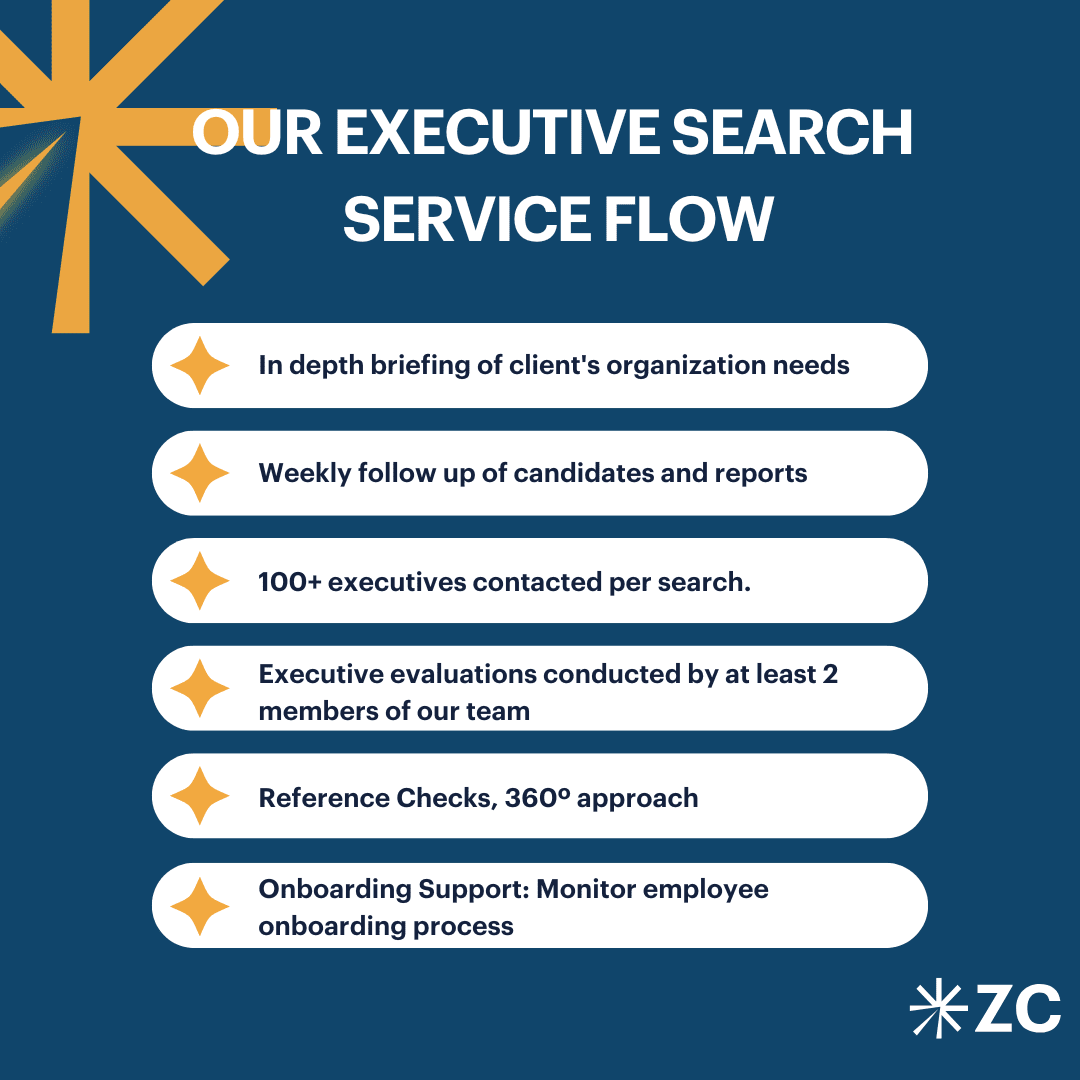
Zavala Civitas’ Executive Search methodology combines market mapping, direct candidate identification, structured assessment and reference validation.
Our Financial Services Executive Search practice supports senior leadership appointments across banking, insurance, investment management and related financial businesses.
Frequently Asked Questions: Financial Services Executive Search in the United States
Financial strength does not eliminate transformation. It creates more strategic choices to lead well.
Zavala Civitas supports U.S. Financial Services organisations in identifying senior executives capable of combining growth, capital discipline, technology and risk leadership.
Executive Search → Financial Services → Contact Us →