
China Business Trends in 2026: What They Mean for Executive Search

Key Takeaway: China’s current business environment is being reshaped by artificial intelligence, digitalisation, new employment models and the transition towards lower-carbon growth. For Executive Search, these trends change the leadership mandate. Companies increasingly need CEOs who can decide where technology creates value, redesign organisations around new capabilities and maintain commercial and human judgement while the operating environment evolves.

Last updated: August 20, 2026

China’s business environment continues to change rapidly as technology, consumer behaviour, organisational structures and industrial priorities evolve. The original version of this article used China’s position in the World Bank’s Doing Business ranking as an indicator of change. However, the World Bank discontinued Doing Business in 2021, so it is no longer an appropriate current benchmark.

A more useful question for Executive Search in 2026 is how structural economic changes are altering the capabilities businesses need from their senior leaders. Artificial intelligence, digital business models, flexible employment and the green transition are developing at different speeds across sectors, requiring executives to make increasingly complex decisions about technology, talent and investment.

Key Figures at a Glance

Data point Finding Source
China GDP growth, H1 2026 4.7% YoY National Bureau of Statistics of China
Digital economy core industries, 2025 More than 10.5% of GDP National Data Administration
China core AI industry, 2025 RMB 1.2+ trillion and 6,200+ companies MIIT / State Council
Flexible employment in China More than 200 million people National People’s Congress / State Council report

China’s Business Environment in 2026: Growth with Structural Change

China’s economy continued to grow in 2026, but growth rates vary significantly between industries. During the first half of the year, GDP increased by 4.7% year on year, while information transmission, software and information technology services grew by 10.7%.

The difference matters for leadership. Companies operating in fast-growing technology-enabled sectors may need executives capable of scaling organisations and allocating investment rapidly, while businesses in slower or more mature markets may require stronger productivity, restructuring or portfolio-management capabilities.

Business formation also remains substantial. In 2025, 25.74 million new business entities were established in China, with approximately 26,000 enterprises created per day on average.

Artificial Intelligence and Digital Transformation in China

Artificial intelligence has moved from a future business trend to a significant part of China’s current industrial environment. The country’s core AI industry exceeded RMB 1.2 trillion in 2025 and included more than 6,200 companies.

AI adoption is also spreading beyond technology companies. By the end of 2025, more than 30% of major manufacturing enterprises had adopted AI technologies. This means executive teams across industrial, consumer, financial and service companies increasingly need to make decisions about AI even when technology is not their primary product.

Public data interpretation: China’s digital economy core industries represented more than 10.5% of GDP in 2025, compared with 7.8% in 2020. The leadership implication is broader than hiring more technology executives. Boards increasingly need CEOs and functional leaders who can determine where digital capabilities belong inside the operating model, which decisions should be automated and how technology investment will produce measurable commercial or operational value.

Flexible Employment and New Organisational Models in China

The structure of China’s labour market has also evolved. A State Council report submitted to the National People’s Congress estimated that more than 200 million people in China participate in flexible employment.

Flexible employment covers a wide range of arrangements and should not be interpreted as a recommendation for companies to replace permanent employees with contractors. It does, however, demonstrate that the traditional permanent, full-time organisational model is no longer the only way talent participates in the Chinese economy.

For CEOs, the challenge is organisational design. Companies need to decide which capabilities are strategically important enough to retain internally, which expertise can be accessed temporarily and how accountability, culture and knowledge transfer should operate when teams include multiple employment models.

More flexible access to talent does not automatically make organisations more agile. The opposite can occur if decision rights, responsibilities and knowledge ownership are unclear. For Executive Search, this means CEOs and CHROs should be assessed on their ability to design the organisation around capabilities and accountability, not simply on whether they have previously implemented flexible-working models.

Consumer behaviour is another area where structural change is visible. In the first half of 2026, online retail sales of goods and services reached RMB 10.07 trillion and increased by 5.2% year on year, while total retail sales of consumer goods increased by 1.3%.

These measures have different statistical scopes, but the contrast illustrates why digital customer journeys remain strategically important. Consumer-facing CEOs need to understand how physical and digital channels interact, how data influences decision-making and whether new channels generate incremental demand or simply redistribute existing sales.

The Green Transition Is Becoming an Operating Issue

Environmental sustainability should no longer be framed only as a change in consumer sentiment. China’s industrial and energy system itself is changing. In 2025, carbon dioxide emissions per RMB 10,000 of GDP fell by 5.0%, while clean-energy electricity generation increased by 14.4% to 4,248.1 billion kWh.

For companies, lower-carbon growth can affect energy sourcing, manufacturing, supply chains, capital expenditure, product strategy and reporting. Executive Search should therefore evaluate whether sustainability responsibilities sit with the CEO, operations, finance, strategy or another function and whether the management team has the capabilities needed to execute them.

What Executive Search Firms Observe on the Ground in China

Current business trends do not create one universal new CEO profile. AI adoption may be central to one company, while another needs to internationalise, improve productivity, restructure its organisation or respond to changing consumer demand.

This means Executive Search firms need to understand the strategic problem before defining the candidate. Searching for a broadly “digital”, “innovative” or “agile” CEO is not specific enough. The relevant question is what transformation the executive will actually be responsible for delivering.

Zavala Civitas Insight: One of the most useful distinctions in transformation-focused Executive Search is between exposure and ownership. Many executives have worked inside companies using AI, restructuring teams or pursuing sustainability programmes. Fewer have personally owned the decisions, investment trade-offs and organisational consequences of those changes. Before mapping candidates, the search should define which transformation outcomes the executive must personally be able to demonstrate.
  • Strategic judgement about AI and technology investment.
  • Ability to redesign organisations around changing capabilities.
  • Commercial understanding of digital customer behaviour.
  • Talent strategy across permanent, flexible and specialised workforces.
  • Capital-allocation and productivity discipline.
  • Ability to lead transformation without losing organisational accountability.
  • Understanding of sustainability as an operational and strategic issue.
  • Cross-cultural and stakeholder-management capability.
  • Ability to develop future leadership talent as roles evolve.

These business trends in China can be affected by different management strategies as well as external factors, and organisations need leaders capable of interpreting which changes are relevant to their specific business rather than following every market trend at the same speed.
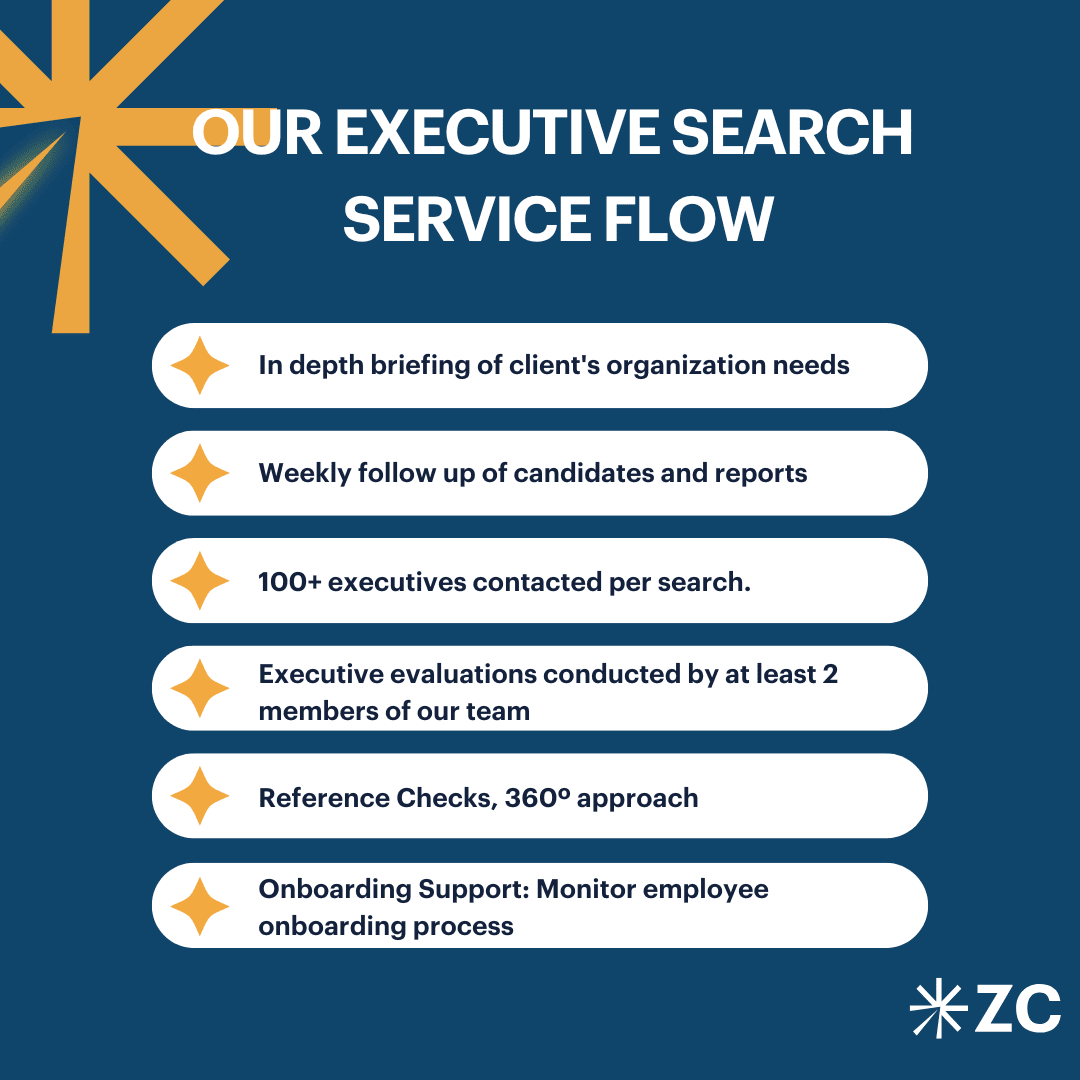
Zavala Civitas executive search methodology for China country

Zavala Civitas Executive Search Methodology for Business Transformation in China

Zavala Civitas begins an Executive Search by understanding the company’s strategic context, organisational environment and critical success factors of the role. When the business is undergoing transformation, the briefing should establish which changes the executive will personally need to lead and which capabilities already exist elsewhere in the management team.

Our Executive Search methodology includes direct contact with more than 100 executives per search, assessment by at least two consultants, 360-degree reference checks and onboarding follow-up during the first six months after appointment.

What are the main business trends affecting Executive Search in China in 2026?
Important structural trends include artificial intelligence, the expansion of the digital economy, new employment models, digital consumer behaviour and lower-carbon industrial development. Their importance differs by sector, so Executive Search should identify which changes materially affect the specific leadership mandate rather than applying one generic CEO profile.
How important is AI to China’s current business environment?
China’s core AI industry exceeded RMB 1.2 trillion and included more than 6,200 companies in 2025. AI adoption is also expanding into manufacturing and other traditional sectors, meaning senior executives increasingly need enough technology judgement to evaluate where AI can create operational or commercial value.
How is flexible employment changing organisational design in China?
China has more than 200 million people engaged in flexible employment. For companies, this expands the ways expertise can be accessed, but leaders still need to define which capabilities should remain internal and how accountability, culture and knowledge transfer should work across different employment models.
What capabilities should companies assess when hiring CEOs during business transformation?
Companies should assess evidence that candidates have personally led the type of transformation required. Relevant capabilities may include technology judgement, organisational redesign, capital allocation, commercial transformation, talent strategy, sustainability and stakeholder management. Previous exposure to change is less informative than evidence of responsibility for decisions and outcomes.
What is Zavala Civitas’s methodology for Executive Search in China?
Zavala Civitas begins with an in-depth briefing to define the organisation, strategic mandate and critical success factors. The firm then maps the relevant market and directly contacts more than 100 executives per search. Candidates are assessed by at least two consultants, finalists undergo 360-degree reference checks and Zavala Civitas supports onboarding during the first six months after appointment. The firm has a 92% Executive Search closing rate.

Leading through business transformation in China?

Zavala Civitas helps organisations identify executives capable of translating technological, organisational and market change into sustainable business performance.

Executive Search → Executive Search in China → Contact Us →


China global market and local focus needed

Executive Search in China: Global Leadership, Local Focus 

Key Takeaway: China accounts for approximately 30% of global AI investment and attracts over $160 billion in annual FDI. The market is not shifting away from international leadership — it is shifting away from international leadership that cannot also operate locally. The executives who succeed are bridge-builders, not transplants. Last

Read More
Executive buildings in China

Why Companies Choose Executive Search in China 

Key Takeaway: China’s GDP grew 4.9% in 2024 and is projected at 4.5% in 2025. 71% of companies in China cite the domestic slowdown as a greater concern than tariffs — and welfare compliance stands at just 28.4%. In this environment, the wrong executive appointment does not create a performance

Read More

Executive Leadership Development: Its Importance and Challenges in China

Key Takeaway: China is the world’s second-largest economy and one of the most active markets for executive leadership development — yet faces structural challenges that most global leadership development frameworks are not designed to address. Confucian hierarchy, an education system historically focused on technical rather than leadership competency, rapid economic

Read More

Related posts

Trabajo en remoto en los despachos de abogados

Autora: Beatriz Baker Araujo Senior Advisor, Zavala Civitas El debate sobre el trabajo presencial y remoto en los despachos de abogados lleva años activo, pero no ha madurado. Las posiciones se han endurecido desde 2020, y las conversaciones suelen discurrir entre dos polos: socios que invocan la cultura, el mentoring

Read More

Executive Search China: Industrial Sector

Key Takeaway: Beijing has launched a nationwide “anti-involution” (反内卷) campaign to address destructive price wars and overcapacity across multiple industrial sectors at once, not just renewables. Electrical machinery and equipment, communications equipment, and medical products all show 29% to 34% of firms losing money in 2024-25. Goldman Sachs estimates Chinese

Read More
Financial services building in Germany

Executive Search in Brazil for Financial Services

Key Takeaway: The White House targeted Brazil’s Pix payment system in April 2026, calling it a barrier to US payment companies. Brazil’s Central Bank fired back, defending Pix as a matter of payments sovereignty. At the same time, the collapse of Banco Master, the largest banking fraud in Brazilian history,

Read More
law leaders working

Executive Search in Mexico for Legal and Professional Services

Key Takeaway: Mexico’s 2024 judicial reform introduced popular election of judges and magistrates, with implementation beginning in 2025. This has accelerated a shift toward arbitration as the preferred dispute-resolution method in commercial contracts, as companies seek predictability an elected judiciary cannot yet guarantee. Combined with nearshoring-driven M&A activity and the

Read More

Executive Search in Italy for Industrial

Key Takeaway: Turin’s automotive cluster invested roughly €2.8 billion in electrification between 2024 and 2026. Over the same period, regional automotive employment fell by more than 3,200 positions. Fewer than 20% of local engineering graduates hold the specific battery, power electronics, and embedded software skills employers are actually hiring for.

Read More

Executive Search in Portugal for Financial Services

Key Takeaway: French banking group BPCE is investing €6.4 billion to acquire Novo Banco and building a 20,000 square metre campus in Lisbon, alongside a 2,500-strong tech hub already operating in Porto. This single deal is creating demand for highly specialised roles in risk analytics, structured finance, and digital-asset compliance

Read More