
China vs Global Management Strategies: An Executive Search View

Key Takeaway: Management strategies in China and global markets are increasingly converging around innovation, AI, resilience and faster decision-making. The difference for executive search is therefore not finding a leader who fits a generic “Chinese” or “Western” management style, but identifying executives who can adapt decision rights, communication, governance and execution speed to the specific operating context.

Last updated: August 20, 2026

The contrast between management strategies in China and the rest of the world is often described too simply. Leadership in China is sometimes presented as inherently hierarchical, fast-moving or relationship-driven, while global management is framed as more decentralised or process-oriented. In practice, the distinction is becoming more nuanced.

Recent evidence shows that Chinese and global CEOs are responding to many of the same pressures: artificial intelligence, geopolitical uncertainty, talent shortages, regulatory complexity and the need for organisational resilience. What differs is often the pace, market context and operating model through which leaders respond.

For companies conducting Executive Search in China, this changes the leadership brief. The strongest candidate is not necessarily the executive who has spent the most time in China or the one with the most international experience. The relevant question is whether that executive can translate strategy between global governance requirements and local execution.

China vs Global Management Strategies in 2026

PwC’s 29th Annual Global CEO Survey provides a useful indication of where the differences now lie. Among CEOs surveyed in Chinese Mainland and Hong Kong SAR, 67% expect significant improvement in global economic growth over the next 12 months, compared with 61% globally.

More significant for leadership strategy is the way innovation is being translated into operations. 52% of Chinese enterprises in the survey report that AI applications have already contributed to revenue growth, compared with 29% globally.

Key Figures at a Glance

Leadership Indicator China Global Leadership Implication
CEOs expecting significant improvement in global economic growth 67% 61% Chinese CEOs show comparatively stronger expectations for near-term global growth.
Companies reporting revenue growth from AI 52% 29% AI leadership is increasingly an operating and commercial capability, not only a technology responsibility.
Enterprises demonstrating strong supply-side resilience 44% 28% Operational resilience and the ability to adapt supply-side decisions remain important executive capabilities.
CEOs identifying digitalisation and connectivity as a top strategic priority 26% 18% Digital transformation has a particularly prominent role in the strategic agenda of surveyed Chinese CEOs.
Public data interpretation: The gap between Chinese and global management strategies is increasingly visible in execution rather than in entirely different strategic objectives. CEOs in both groups are prioritising technology, talent and resilience, but the higher reported AI revenue impact and supply-side resilience among surveyed Chinese companies suggest that executive assessment in China should test how quickly a leader can translate strategy into operational decisions.

How AI Is Changing Management Strategies in China

The shift is particularly visible in technology-enabled organisations. A 2025 Boston Consulting Group study of 160 senior executives at Chinese companies found increasing emphasis on strategic vision, delegation and employee empowerment rather than traditional monitoring and control.

In the study, 85% of respondents identified strategic vision as important for successful leadership in AI-enabled companies, while 75% highlighted delegation and empowerment.

This matters because it challenges an outdated assumption that effective management in China necessarily depends on more centralised control. In fast-changing organisations, particularly those integrating AI, leaders may instead need to define strategic direction clearly while allowing teams to make decisions closer to the market.

Zavala Civitas Insight: In cross-border executive search, “China experience” should not be treated as a sufficient proxy for leadership fit. A more useful assessment is whether the executive understands which decisions should remain aligned with global headquarters, which decisions need to be delegated locally, and how quickly information must move between the two. This distinction often reveals more about a candidate’s ability to lead a China operation than nationality or years spent in the market.

Executive Search in China: Assessing Context Rather Than Stereotypes

Management strategy is shaped by institutions, ownership structures, industry, organisational maturity and the executive’s mandate. Recent academic research reinforces the importance of this context. A 2026 review of 134 strategic leadership studies conducted in China found substantial variation in how Chinese context influences leadership mechanisms.

For executive search, this means avoiding a generic “China profile”. A Country Manager for a European industrial group, a CEO of a Chinese technology company expanding internationally and a regional executive leading an Asia-Pacific platform may all operate in China, but the leadership capabilities required are materially different.

A useful executive search brief should therefore clarify the specific management environment before the candidate market is mapped. This includes decision-making authority, reporting relationships, regulatory exposure, headquarters expectations, speed of execution, stakeholder complexity and the degree of organisational transformation the executive is expected to lead.

This is also why global leadership and local execution need to be assessed together. An executive who succeeds in one operating model may struggle when the balance between local autonomy and global governance changes.

What Cross-Border Leaders in China Need to Manage

1. Decision speed and governance

Leaders need to move quickly without disconnecting the China operation from global governance. The challenge is not choosing between speed and control, but designing clear decision rights so that each can coexist.

2. Innovation and commercialisation

Innovation leadership is increasingly linked to measurable business results. PwC reports that nearly half of surveyed Chinese CEOs consider innovation a critical part of their overall business strategy. Executive assessment should therefore distinguish experience managing innovation programmes from the ability to turn innovation into revenue, productivity or market advantage.

3. Local autonomy and headquarters alignment

Multinational executives operating in China frequently need to interpret global strategy rather than simply implement it. They must understand when local adaptation creates competitive advantage and when it introduces governance or execution risk.

4. Talent and organisational change

As AI changes workflows and information flows, executives increasingly need to manage organisational redesign alongside technology adoption. The leadership challenge is therefore as much about people, delegation and accountability as it is about the underlying technology.

Zavala Civitas Executive Search in China

For Zavala Civitas, an executive search in China begins with the business problem rather than a predefined candidate profile. The first question is not simply which executives have worked in the market, but what the incoming leader is expected to change, protect or accelerate.

Our Executive Search methodology combines detailed briefing, market mapping, direct candidate identification, structured executive assessment, reference validation and support through the appointment and onboarding process.

For cross-border assignments, this approach allows the search to test both sides of the mandate: whether a candidate can perform within the realities of the Chinese market and whether that same executive can operate effectively within an international governance structure.
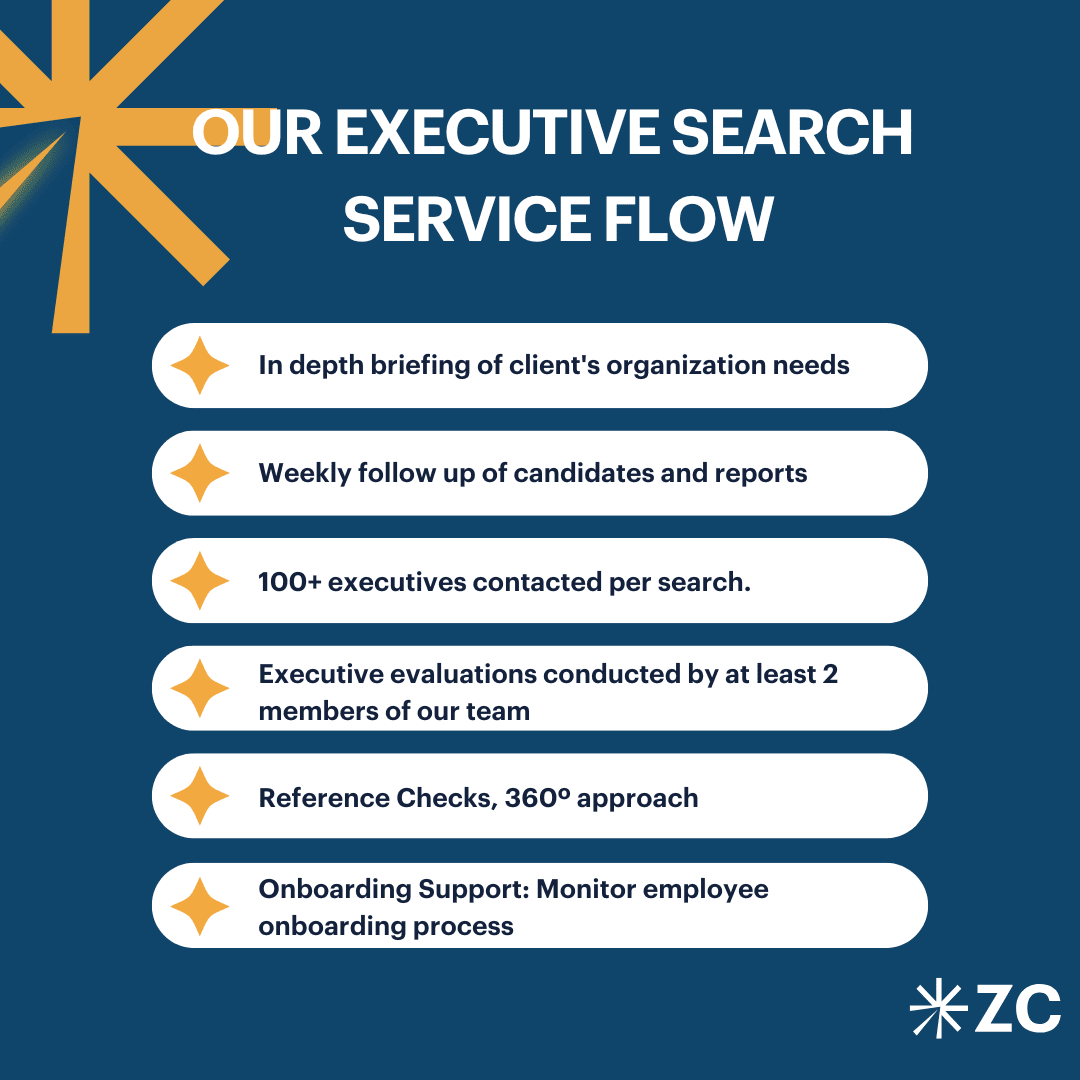
Zavala Civitas executive search methodology for China country

Frequently Asked Questions: Management Strategies and Executive Search in China

How do management strategies in China differ from global management strategies?
The difference is increasingly contextual rather than a simple contrast between Chinese and Western leadership styles. Companies in China and global markets are both prioritising innovation, AI, resilience and talent, but leaders operating in China may need to combine faster local execution with the governance, reporting and risk requirements of an international organisation.
What leadership capabilities are becoming more important in China?
Strategic vision, innovation, delegation, resilience and the ability to translate technology into commercial value are increasingly important. A BCG survey found that 85% of participating Chinese executives identified strategic vision as important for leaders in AI-enabled companies, while 75% highlighted delegation and empowerment.
Why does executive search in China require local market context?
Because two positions with the same title can require very different leadership behaviours depending on ownership structure, headquarters relationships, regulatory exposure, industry, decision rights and the degree of local autonomy. Executive search therefore needs to define the actual operating environment before determining which candidates represent the strongest fit.
Should companies prioritise Chinese or international executives for leadership roles in China?
Nationality alone is not a reliable predictor of leadership effectiveness. Companies should assess whether the candidate can navigate the local market while meeting the organisation’s global requirements for governance, strategy, communication and performance. Depending on the mandate, the strongest candidate may be local, international or a leader with substantial cross-border experience.
How does Zavala Civitas conduct Executive Search in China?
Zavala Civitas begins with an in-depth definition of the organisation’s needs and translates the business mandate into specific leadership capabilities. The Executive Search methodology then combines market mapping, direct candidate identification, structured assessment, reference validation and support throughout the appointment and onboarding process. For China assignments, the assessment considers both local execution capability and alignment with global governance and headquarters expectations.

Need leadership that can connect global strategy with execution in China?

Zavala Civitas supports organisations in identifying and assessing senior executives for complex cross-border leadership mandates.

Executive Search → Executive Search in China → Contact Us →


China global market and local focus needed

Executive Search in China: Global Leadership, Local Focus 

Key Takeaway: China accounts for approximately 30% of global AI investment and attracts over $160 billion in annual FDI. The market is not shifting away from international leadership — it is shifting away from international leadership that cannot also operate locally. The executives who succeed are bridge-builders, not transplants. Last

Read More
Executive buildings in China

Why Companies Choose Executive Search in China 

Key Takeaway: China’s GDP grew 4.9% in 2024 and is projected at 4.5% in 2025. 71% of companies in China cite the domestic slowdown as a greater concern than tariffs — and welfare compliance stands at just 28.4%. In this environment, the wrong executive appointment does not create a performance

Read More

Executive Leadership Development: Its Importance and Challenges in China

Key Takeaway: China is the world’s second-largest economy and one of the most active markets for executive leadership development — yet faces structural challenges that most global leadership development frameworks are not designed to address. Confucian hierarchy, an education system historically focused on technical rather than leadership competency, rapid economic

Read More

Related posts

Trabajo en remoto en los despachos de abogados

Autora: Beatriz Baker Araujo Senior Advisor, Zavala Civitas El debate sobre el trabajo presencial y remoto en los despachos de abogados lleva años activo, pero no ha madurado. Las posiciones se han endurecido desde 2020, y las conversaciones suelen discurrir entre dos polos: socios que invocan la cultura, el mentoring

Read More

Executive Search China: Industrial Sector

Key Takeaway: Beijing has launched a nationwide “anti-involution” (反内卷) campaign to address destructive price wars and overcapacity across multiple industrial sectors at once, not just renewables. Electrical machinery and equipment, communications equipment, and medical products all show 29% to 34% of firms losing money in 2024-25. Goldman Sachs estimates Chinese

Read More
Financial services building in Germany

Executive Search in Brazil for Financial Services

Key Takeaway: The White House targeted Brazil’s Pix payment system in April 2026, calling it a barrier to US payment companies. Brazil’s Central Bank fired back, defending Pix as a matter of payments sovereignty. At the same time, the collapse of Banco Master, the largest banking fraud in Brazilian history,

Read More
law leaders working

Executive Search in Mexico for Legal and Professional Services

Key Takeaway: Mexico’s 2024 judicial reform introduced popular election of judges and magistrates, with implementation beginning in 2025. This has accelerated a shift toward arbitration as the preferred dispute-resolution method in commercial contracts, as companies seek predictability an elected judiciary cannot yet guarantee. Combined with nearshoring-driven M&A activity and the

Read More

Executive Search in Italy for Industrial

Key Takeaway: Turin’s automotive cluster invested roughly €2.8 billion in electrification between 2024 and 2026. Over the same period, regional automotive employment fell by more than 3,200 positions. Fewer than 20% of local engineering graduates hold the specific battery, power electronics, and embedded software skills employers are actually hiring for.

Read More

Executive Search in Portugal for Financial Services

Key Takeaway: French banking group BPCE is investing €6.4 billion to acquire Novo Banco and building a 20,000 square metre campus in Lisbon, alongside a 2,500-strong tech hub already operating in Porto. This single deal is creating demand for highly specialised roles in risk analytics, structured finance, and digital-asset compliance

Read More