
The Case for Executive Leadership Development in Portugal

Key Takeaway: Portuguese business culture emphasises hierarchy and risk aversion — creating specific leadership development challenges that standard global frameworks are not calibrated to address. SMEs dominate the Portuguese economy, limiting the scale of internal development programmes. Digital transformation is requiring leaders to develop technological adaptability alongside traditional management competence. And Portugal’s increasing importance as a nearshoring hub for European and international companies is creating demand for a new generation of globally oriented Portuguese executives whose development requirements are materially different from those of the previous generation.

Last updated: August 13, 2026

The significance of effective leadership in today’s fast-changing business environment cannot be overemphasised. In Portugal, companies that are not investing in executive leadership development are at a competitive disadvantage. This article explores the peculiar challenges encountered while developing leadership within Portuguese organisations and outlines why such development is vital for organisational and economic success. Learn more about our executive assessment and leadership development programme.
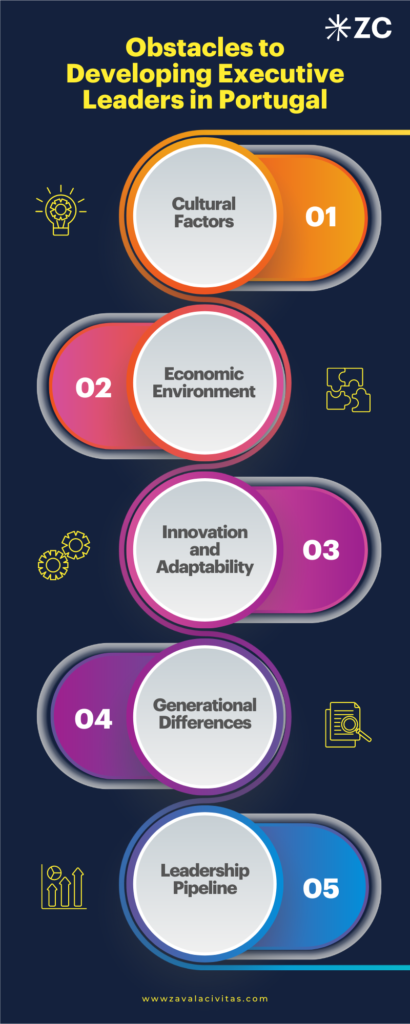
Executive leadership development process in Portugal — Zavala Civitas

Key Figures at a Glance

Context factor Leadership development implication
SME economic dominance Majority of Portuguese economy — SME scale limits capacity for structured internal leadership development programmes
Cultural hierarchy and risk aversion Stifles open communication and bold strategy — specific challenge for leadership development programmes designed to build collaborative and innovative leadership
Nearshoring hub growth Portugal increasingly attractive for European and international companies — creating demand for Portuguese executives with global leadership competency
Digital transformation demand Digital literacy required as a core leadership competency — not just technical capability but strategic governance of digital transformation

Obstacles to Developing Leaders in Portugal

  1. Cultural factors: Portuguese business culture emphasises hierarchy and respect for authority — which may stifle the open communication and collaborative innovation that effective leadership development programmes are designed to build. An inclination towards risk aversion discourages leaders from engaging with the bold or transformative strategies that global competitiveness increasingly requires.
  2. Economic environment: Executive leadership development programmes suffer during tough economic times when training budgets are cut. SMEs dominate the Portuguese economy and frequently lack the capacity to establish and sustain the leadership initiatives that larger organisations can fund — concentrating development investment in a fraction of the employer base.
  3. Innovation and adaptability: Resistance to change can hamper both organisations and individuals — and the pace of technological advancement has made adaptability one of the most urgently demanded leadership characteristics, making digital literacy and innovation integration into leadership programmes a necessity that is not yet universal.
  4. Generational differences: Different generations come with diverse expectations and approaches to leadership. Creating programmes that meet generational diversity needs — bridging traditional authority-based leadership styles and the collaborative, flat-hierarchy expectations of younger Portuguese professionals — is both challenging and essential for development programme effectiveness.
  5. Leadership pipeline: Identifying potential leaders within organisations and nurturing them requires effective talent management strategy. Retaining talented individuals is equally essential, since high staff turnover disrupts the continuity that long-term leadership development programmes depend on — and Portuguese talent mobility is increasing as the nearshoring economy creates more competitive employer alternatives.
  6. Global competitiveness: Portuguese companies must have leaders who understand global trends and can navigate cross-cultural management if they are to compete in international markets — requiring focus on global awareness, cross-cultural competency, and strategic thinking in leadership development programmes that have historically been locally oriented.
  7. Regulatory and policy environment: Portugal has a complex regulatory environment — navigating compliance with local laws and EU regulations requires time-consuming attention that can reduce the development investment bandwidth available for strategic and leadership capability building.
Portugal’s nearshoring attraction — for European, American, and Asian companies establishing operations that require leadership capable of managing across borders — is creating a specific leadership development demand that the traditional Portuguese executive pipeline has not been developed to meet at the required scale. The Portuguese executive who has led a domestic Portuguese operation successfully has built the financial management, team leadership, and customer relationship management capabilities that domestic operations require. The Portuguese executive who will lead a shared services centre serving 12 European countries, or an innovation hub integrating product teams from 4 continents, or a manufacturing operation supplying a Japanese company’s European market — needs additional cross-cultural leadership competency, global governance capability, and international stakeholder management that domestic executive experience does not automatically develop. Executive leadership development investment that specifically targets these global-readiness competencies for the Portuguese executive population is the development priority that Portugal’s growing role in the global economy most urgently creates.

The Importance of Executive Leadership Development to Portugal

  1. Enhancing organisational performance: Effective leadership training equips leaders with skills required for informed decision-making and strategic planning — promoting organisational performance and increasing productivity through the management capability that converts strategic intent into operational execution.
  2. Driving innovation and competitiveness: Leadership training fosters innovation culture by teaching executives to think outside the box and embrace technological advances — building the global competitiveness that preparing leaders for cross-cultural management and international market competition requires.
  3. Adaptation to change: Raising leaders who can guide companies through economic change and seize digital transformation opportunities — while remaining agile enough to integrate new tools and platforms without disrupting operational continuity — is the specific development investment that Portugal’s pace of economic change demands.
  4. Talent retention and employee engagement: Leadership development investment communicates the company’s commitment to employee growth — reducing turnover by enhancing job satisfaction and creating the engaged workforce that effective leadership enables.
  5. Succession planning: Identifying and grooming future leaders ensures smooth transitions, maintains leadership continuity, and mitigates the risks associated with abrupt exits or leadership gaps that are particularly costly in SME environments where individual leader knowledge concentration is highest.
  6. Cultural and social impact: Leaders who shape organisational culture toward inclusion and positive working environments drive productivity across all levels of the organisation — and leaders with strong ethical principles implement the corporate social responsibility initiatives that benefit communities and enhance company reputation.
  7. Economic growth and development: Strong company-level governance leads to increased national economic performance — and leadership development that enables entrepreneurship and innovation contributes to an active Portuguese economy increasingly positioned at the centre of European and Atlantic business flows.
  8. Regulatory and compliance excellence: Knowledgeable executives ensure compliance with local and international laws — averting legal exposure while maintaining the corporate governance standards that international investors, parent companies, and EU regulatory frameworks require of Portuguese-based operations.

Effective executive leadership development is pivotal in improving organisational performance, driving innovation, ensuring adaptability, retaining talent, and contributing to economic growth. This can be achieved through customised development programmes that target Portugal’s specific leadership context — cultural hierarchy and risk aversion, SME scale constraints, digital transformation requirements, and the global-readiness gap that Portugal’s growing nearshoring economy most urgently demands.

Click here to get in contact with us.

Frequently Asked Questions: Executive Leadership Development in Portugal

Why does Portugal’s nearshoring growth create leadership development requirements that the traditional Portuguese executive pipeline hasn’t been built to meet?
Because the Portuguese executive who has led a domestic Portuguese operation has built capabilities for the domestic context — but leading a shared services centre serving 12 European countries, an innovation hub integrating teams from 4 continents, or a manufacturing operation supplying a Japanese company’s European market requires additional cross-cultural leadership competency, global governance capability, and international stakeholder management that domestic executive experience does not automatically develop. The nearshoring economy is creating global leadership demand faster than the domestic executive development pipeline is producing global-ready Portuguese executives.
How does Portuguese cultural hierarchy specifically challenge leadership development programmes designed to build collaborative and innovative leadership?
Because the leadership development frameworks designed to build collaborative management, constructive challenge of authority, and innovative risk-taking assume a cultural starting point where hierarchical deference is weaker than it is in Portuguese professional culture. The Portuguese executive who has built their career in an environment where hierarchical respect is deeply ingrained will process collaborative leadership development differently from an executive whose career formation assumed flat structures and individual expression of disagreement. Effective programme design acknowledges the cultural starting point and builds the target competencies through culturally resonant approaches.
What specific constraint does SME dominance create for executive leadership development investment in Portugal?
Because structured internal leadership development programmes require a minimum scale of management layers, development programme budget, and senior executive mentoring bandwidth that most Portuguese SMEs cannot sustain. The SME that recognises a leadership gap in its executive team has limited options to address it internally — making external executive coaching, industry association leadership development programmes, and structured succession planning support from executive search and advisory firms the accessible alternatives that match SME scale and budget constraints.
Why is digital literacy now a core leadership competency requirement in Portugal rather than a technical specialisation?
Because the speed of technological change in Portuguese business — across fintech, logistics, manufacturing digitalisation, and the technology services that Portugal’s nearshoring economy is increasingly built on — means that the executive who governs digital transformation decisions without personal technological literacy is making investment decisions they cannot evaluate independently. The Portuguese executive leader who relies entirely on technology team recommendations for digital transformation direction cannot provide the governance oversight, vendor evaluation challenge, or strategic sequencing judgment that effective digital investment at the board and C-suite level requires.
How does Zavala Civitas approach executive leadership development in Portugal?
Through customised development programmes that target Portugal’s specific leadership context — cultural hierarchy and risk aversion as starting assumptions, SME-appropriate programme scale and delivery, digital transformation governance capability, global-readiness development for Portuguese executives in the nearshoring economy, and cross-cultural leadership competency for executives managing international stakeholders. Learn more at our executive assessment and leadership development programme.

Executive leadership development programme for Portugal?

Zavala Civitas provides Portugal-specific leadership development — culturally resonant frameworks, global-readiness for nearshoring economy demands, and SME-appropriate programme delivery.


Assessment & Development →
Executive Search →
Contact Us →

Related posts

Trabajo en remoto en los despachos de abogados

Autora: Beatriz Baker Araujo Senior Advisor, Zavala Civitas El debate sobre el trabajo presencial y remoto en los despachos de abogados lleva años activo, pero no ha madurado. Las posiciones se han endurecido desde 2020, y las conversaciones suelen discurrir entre dos polos: socios que invocan la cultura, el mentoring

Read More

Executive Search China: Industrial Sector

Key Takeaway: Beijing has launched a nationwide “anti-involution” (反内卷) campaign to address destructive price wars and overcapacity across multiple industrial sectors at once, not just renewables. Electrical machinery and equipment, communications equipment, and medical products all show 29% to 34% of firms losing money in 2024-25. Goldman Sachs estimates Chinese

Read More
Financial services building in Germany

Executive Search in Brazil for Financial Services

Key Takeaway: The White House targeted Brazil’s Pix payment system in April 2026, calling it a barrier to US payment companies. Brazil’s Central Bank fired back, defending Pix as a matter of payments sovereignty. At the same time, the collapse of Banco Master, the largest banking fraud in Brazilian history,

Read More
law leaders working

Executive Search in Mexico for Legal and Professional Services

Key Takeaway: Mexico’s 2024 judicial reform introduced popular election of judges and magistrates, with implementation beginning in 2025. This has accelerated a shift toward arbitration as the preferred dispute-resolution method in commercial contracts, as companies seek predictability an elected judiciary cannot yet guarantee. Combined with nearshoring-driven M&A activity and the

Read More

Executive Search in Italy for Industrial

Key Takeaway: Turin’s automotive cluster invested roughly €2.8 billion in electrification between 2024 and 2026. Over the same period, regional automotive employment fell by more than 3,200 positions. Fewer than 20% of local engineering graduates hold the specific battery, power electronics, and embedded software skills employers are actually hiring for.

Read More

Executive Search in Portugal for Financial Services

Key Takeaway: French banking group BPCE is investing €6.4 billion to acquire Novo Banco and building a 20,000 square metre campus in Lisbon, alongside a 2,500-strong tech hub already operating in Porto. This single deal is creating demand for highly specialised roles in risk analytics, structured finance, and digital-asset compliance

Read More