Key Takeaway: American companies invest $1,057 per employee annually in leadership development — totalling an impressive $166 billion (Forbes). Yet the US leadership development market’s size and diversity creates significant complexity: regional economic disparities, industry-specific regulatory demands, organisational culture variation between startups and established companies, and the pace of technological change all require leadership development programmes that are genuinely customised rather than standardised. Providers who navigate this complexity with ad hoc, value-adding approaches at every stage — from needs assessment through continued post-programme support — build the sustainable leadership pipelines that $166 billion in aggregate investment frequently fails to produce.
Last updated: August 13, 2026
Any organisation that is to succeed in today’s competitive, ever-changing business world must invest in executive development. At the executive level, effective leadership drives strategic vision, fosters innovation, and helps companies navigate complex challenges. The US is one country whose leadership development market is highly complex — influenced by regional differences, industry-specific needs, organisational culture, regulatory environments, and technological advancements that must all be addressed in effective executive development programmes. Learn more about our executive assessment and leadership development programme.
Key Figures at a Glance
| Data point |
Finding |
Source |
| US leadership development investment per employee annually |
$1,057 per employee |
Forbes Magazine |
| Total US annual leadership development expenditure |
$166 billion |
Forbes Magazine |
| Canadian comparison — leadership training investment per employee |
~$507 (estimated share of $1,014 total training investment) |
Canadian training & development market analysis |
| Key complexity driver |
Regional disparities + industry-specific regulatory requirements + organisational culture variation + technological change pace |
US leadership development market analysis |
Significance of Executive Leadership Development
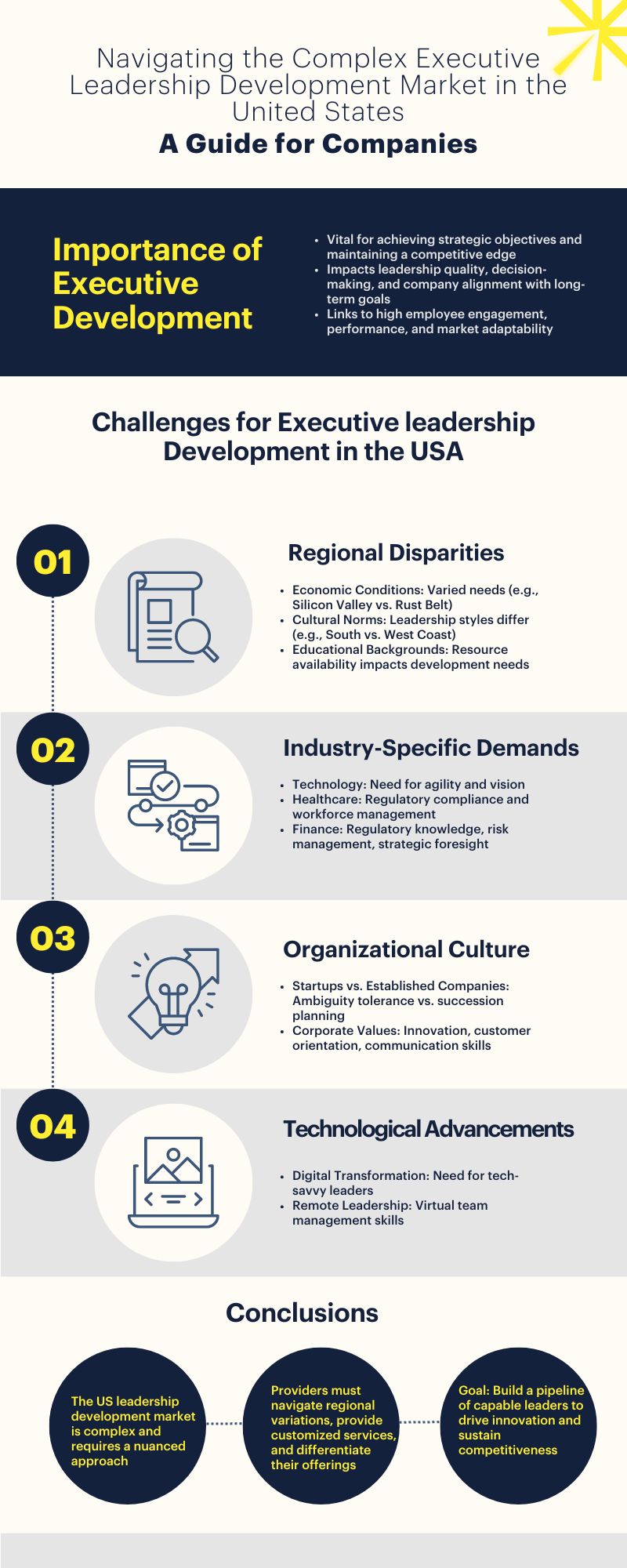
Executive development is a crucial investment for organisations since it directly impacts their ability to achieve strategic objectives and maintain competitive advantage. Well-developed leaders inspire and guide teams, make informed decisions, and implement strategies that align with long-term goals. Strong leadership links to high employee engagement, good organisational performance, and adaptability to market changes — making leadership development investment one of the most measurable contributors to sustained organisational competitiveness.
The $166 billion in US annual leadership development expenditure is one of the largest single-category training investments in any market in the world — and one of the most poorly correlated with leadership effectiveness outcomes across the organisations that make it. The correlation failure is not because leadership development doesn’t work. It is because $166 billion in aggregate investment contains both the highly customised, needs-assessment-grounded, outcomes-measured programmes that produce measurable leadership capability improvement and the standardised, off-the-shelf, one-size-fits-all programmes that consume development budget while producing credential activity that organisations mistake for development progress. The most consequential question for any US organisation investing in leadership development is not “how much should we spend?” — which the $1,057 per employee benchmark answers for them. It is “how do we ensure the programme we are funding produces leadership capability improvement in the specific leaders with the specific gaps in our specific organisational context?” That specificity is what separates the top quartile of US leadership development investment from the bottom quartile, regardless of budget level.
Regional Disparities in the USA
The United States’ size and diversity creates significant regional variation in leadership development requirements. Silicon Valley’s booming technology industry requires leaders skilled in innovation management and rapid-growth operations — unlike regions such as the Rust Belt which may seek to reinvigorate manufacturing or address labour market challenges with different leadership competency requirements. Cultural norms about authority, hierarchy, and leadership style also vary materially by region — and the availability of educational resources varies across states, affecting both the type of leadership development needed and the local provision available.
Industry-Specific Demands
- Technology: Leaders must be agile and visionary due to fast-paced innovation cycles and a high degree of change — with AI governance and digital transformation capability now core requirements alongside the strategic vision that technology sector leadership has always required.
- Healthcare: Leadership must navigate complex regulatory environments, ensure HIPAA compliance, manage a diverse workforce, and govern the digital health transformation simultaneously — a regulatory complexity that technology sector leadership development frameworks are not designed to address.
- Finance: Without regulatory knowledge (SEC, Dodd-Frank, Basel III), risk management capability, and strategic foresight, financial services leaders will consistently underperform the demands of the regulatory environment in which they operate.
Organisational Culture
Every organisation has its own culture, which profoundly influences its leadership development needs. Startups need leaders who can manage through ambiguity, make decisions with incomplete information, and build organisational capability from minimal foundation — while established companies may emphasise succession planning, leadership continuity, and avoiding the cultural disruption that poorly calibrated leadership development can create. Organisations emphasising innovation need leaders capable of fostering creativity and driving change; those with customer-oriented cultures may stress empathy, stakeholder communication, and service excellence as the primary leadership competencies to develop.
The Importance of Ad Hoc Leadership Development Services
The ad hoc nature of leadership development services is crucial in responding to the complexity that the US market creates. Companies need customised solutions that meet the unique combination of their organisational culture, industry regulatory environment, regional talent market, and strategic objectives simultaneously. This customisation involves personalised coaching, context-specific case studies, real-life application projects, and ongoing measurement of development investment against organisational performance outcomes — not just participant satisfaction scores.
Differentiating Leadership Development Services
- Tailored and personalised solutions: Leadership development should not be a standard training programme — it should be tailored by understanding the organisation’s specific needs at both the macro strategic level and the individual leader’s specific capability gap level simultaneously.
- All-round approach: A combination of workshops, one-on-one coaching, experiential learning, and peer mentoring creates the breadth of development input that produces leadership capability improvement rather than knowledge exposure alone.
- Sustainable outcomes: Leadership development should be measured over a longer period requiring improvements in leadership effectiveness and consequently organisational performance — not just completion rates, participant feedback scores, or knowledge test results that do not predict actual leadership performance improvement.
The US leadership development market’s scale and complexity requires a nuanced approach. Providers must navigate significant regional variation while providing the ad hoc, value-adding services that differentiate effective from ineffective leadership investment — meeting the unique needs of each organisation’s specific leadership gaps within their specific regulatory, cultural, and strategic context.
Click here to get in contact with us.
Frequently Asked Questions: Executive Leadership Development in the USA
Why is $166 billion in US annual leadership development expenditure poorly correlated with leadership effectiveness outcomes across organisations?
Because the aggregate investment contains both the highly customised, needs-assessment-grounded, outcomes-measured programmes that produce measurable leadership capability improvement and the standardised, off-the-shelf programmes that consume development budget while producing credential activity that organisations mistake for development progress. The correlation failure is not because leadership development doesn’t work — it is because the programmes doing the most work are a minority of the total investment. The specificity question — how to ensure the programme produces leadership capability improvement in the specific leaders with the specific gaps in the specific organisational context — is what separates the top quartile of US leadership development investment from the bottom quartile.
How does regional variation in the US specifically require different executive leadership development approaches beyond just adjusting content?
Because regional variation extends to the talent pool available for the development cohort, the business culture context in which development activities take place, and the competitive labour market conditions that determine whether developed leaders are retained long enough to deliver the return on the development investment. A leadership development programme designed for Silicon Valley’s innovation culture and high-mobility talent market will systematically underdeliver in a Rust Belt manufacturing context where organisational culture, leadership style norms, workforce demographics, and talent market conditions require completely different design choices.
What specific regulatory leadership competency does the US healthcare sector’s leadership development requirement create that technology sector programmes don’t address?
The ability to navigate HIPAA data privacy obligations in digital health transformation decisions, manage the FDA approval pathway implications for health technology investments, and govern the joint commission and CMS accreditation compliance environment alongside the operational and strategic leadership requirements that healthcare executives share with other sector leaders. Healthcare leadership development programmes that address regulatory competency as a module within a general leadership framework rather than as the contextual constraint within which all leadership decisions are made will produce leaders who understand regulations abstractly without the specific judgment that managing the healthcare regulatory environment in real-time decisions requires.
How does measuring leadership development outcomes against organisational performance differ from standard participant satisfaction measurement?
Because participant satisfaction reflects how leaders feel about the development experience — which correlates with programme quality and relevance but does not directly measure leadership capability improvement or its downstream impact on team performance, decision quality, or organisational outcomes. Measuring against organisational performance requires pre-programme assessment of specific leadership capability gaps, post-programme measurement of those specific capabilities, and follow-on measurement of team and organisational performance outcomes over 12–24 months. That measurement framework is more expensive and slower to produce results, and it consistently shows that the programmes with the highest participant satisfaction scores do not always produce the highest leadership capability improvement.
How does Zavala Civitas approach executive leadership development in the United States?
Through comprehensive needs assessment that identifies specific leadership capability gaps — not average gaps across a generic leadership competency framework — followed by customised programme design that addresses the specific regional, industry regulatory, and organisational culture context of each client. We integrate coaching, experiential learning, peer mentoring, and formal instruction in combinations that the needs assessment identifies as most effective for each specific development challenge. We measure outcomes against leadership capability improvement and organisational performance, not participant satisfaction scores. Learn more at our
executive assessment and leadership development programme.
Leadership development programme for US executives?
Zavala Civitas provides customised US executive leadership development — specific needs assessment, industry-regulatory context, organisational culture calibration, and outcomes measured against leadership capability improvement.
Assessment & Development →
Executive Search →
Contact Us →