
Last updated: August 13, 2026
Partner assessment centres for promotions are one of the most important processes in law firms both for the individuals under consideration and for the organisation itself. Firms invest heavily in selecting the right candidates but often overlook a critical factor: the impact on those who are not promoted.
When this process lacks transparency or developmental follow-up, it can lead to dissatisfaction, disengagement, and ultimately the loss of experienced senior lawyers who, despite not being ready today, represent the firm’s most valuable future leadership pipeline.
Key Figures at a Glance
| Data point | Finding | Source |
|---|---|---|
| Associate attrition rate in U.S. law firms (2024) | 20% (down from 26% peak in 2021) | NALP Foundation |
| Associates who felt their firm was not actively trying to retain them | 60% | Major, Lindsey & Africa |
| Cost of a failed promotion to partner (lost productivity + replacement) | Up to 2.5× the lawyer’s annual compensation | Gartner |
| Outcome of firms investing in formal partner development programmes | Stronger retention and better succession outcomes reported | Citrin Cooperman |
Partner Assessment Centres: Beyond Selection
Partner Assessment Centres offer more than just a selection mechanism. They provide a structured framework that helps firms not only make better promotion decisions — but also retain and develop key talent for the future. For the candidates who are promoted and those who are not, the assessment experience shapes their relationship with the firm for years after the outcome is communicated.
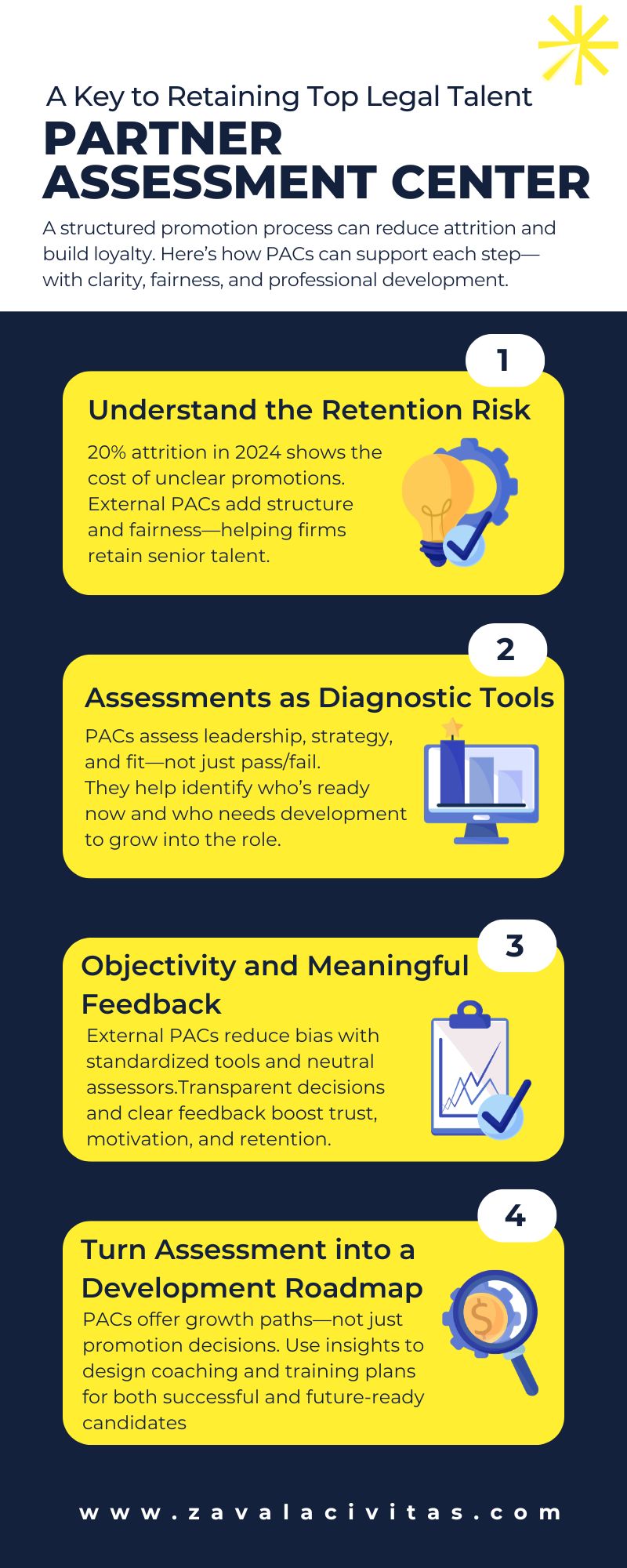
1. Understand the Retention Risk
Unclear promotion outcomes can erode trust and morale. According to the NALP Foundation, the associate attrition rate in U.S. law firms reached 20% in 2024 — while below the 2021 peak of 26%, it still represents a significant threat to knowledge continuity and client relationships.
A separate survey by Major, Lindsey & Africa found that 60% of associates felt their firms were not actively trying to retain them. Partner Assessment Centres help address these challenges by providing greater clarity, fairness, and communication in the promotion process shifting the experience from gatekeeping to investment.
2. Use Assessments as Diagnostic Tools
Partner Assessment Centres go beyond a simple pass/fail outcome. They evaluate a wide range of competencies leadership, business acumen, strategic thinking, and cultural alignment providing a detailed snapshot of a candidate’s readiness for partnership.
This diagnostic approach allows firms to identify not only who is ready today, but who has the potential to grow into the role and what specific development areas to focus on. For firms managing a generation of high-billing associates who are 12–24 months away from readiness, the diagnostic data is as valuable as the selection outcome.
3. Ensure Objectivity, Transparency, and Meaningful Feedback
One of the main risks in traditional promotion processes is unconscious bias — whether based on personality, internal visibility, or personal relationships. Partner Assessment Centres mitigate this by using standardised tools, multiple assessors, and evidence-based criteria. This makes the process more transparent, defensible, and equitable.
Involving a third-party provider further enhances objectivity. External assessors bring neutrality, minimise internal politics, and ensure that feedback is focused solely on performance and potential rather than on the informal relationship dynamics that shape how senior associates are perceived within the firm.
The value of a Partner Assessment Centre lies not only in its design, but in how results are communicated. Clear, respectful feedback helps candidates understand decisions, identify development areas, and remain motivated. When the process is transparent and feedback is constructive, candidates are far more likely to view the experience as a professional development opportunity not a rejection. This reduces disengagement, promotes trust, and reinforces a culture of growth.
4. Turn Assessment into a Development Roadmap
For those not promoted, a Partner Assessment Centre should not be seen as a barrier but as a foundation for growth. The insights generated through assessments — via simulations, structured interviews, and psychometric data can be used to shape personalised development plans.
These may include tailored 1-to-1 coaching, high-visibility assignments, or internal mentorship designed to build readiness for future promotion rounds. For instance, a senior associate who did not progress through the Partner Assessment Centre might receive a coaching plan focused on specific identified development areas — such as business development or strategic client relationship management — with clear milestones and a defined timeline for reassessment.
Equally, those who are selected should also engage in structured development programmes — to strengthen their leadership capabilities and ensure they succeed in their new role as partner from day one. According to Citrin Cooperman, firms that invest in formal partner development programmes report stronger retention and better succession outcomes.
The key is to position the assessment not as a verdict — but as the beginning of a structured leadership journey.
Conclusion
Partner Assessment Centres offer firms a chance to do more than select partners — they create a framework for fair evaluation, targeted development, and transparent communication. Firms that approach promotion as a leadership journey — not a gatekeeping decision — are better positioned to build loyalty, increase diversity, and secure their future leadership bench.
Click here to get in contact with us.
Frequently Asked Questions: Partner Assessment Centres and Talent Retention in Law Firms
Using your Partner Assessment Centre as a retention tool as well as a selection mechanism?
Zavala Civitas designs and delivers Partner Assessment Centres for law firms, with development roadmaps for every candidate. Senior Advisor: Beatriz Baker Araujo.
Assessment & Development →
Legal & Professional Services →
Contact Us →