Key Takeaway: 70% of Mexican companies are family-owned, yet only 15% have formal succession plans. PwC Mexico estimates over 60% of corporate boards lack formal succession planning at any level. In a market receiving $41 billion in annual FDI and scaling operations faster than leadership development can keep pace, executive assessment and development is not an HR programme — it is the mechanism that determines whether Mexico’s business growth translates into durable organisational capability.
Last updated: August 13, 2026
Mexico, the second-largest economy in Latin America, is undergoing a period of economic transformation and uncertainty. While the country showed resilience in the aftermath of the COVID-19 pandemic, the latest data from Banco de México projects a modest GDP growth of around 2.4% for 2024, amid inflation concerns, political transitions, and fluctuating global trade dynamics.
Additionally, Mexico’s proximity and trade dependency on the U.S. economy through the USMCA brings both opportunities and vulnerabilities. In the Automotive and Energy Manufacturing industries, factors such as low productivity, lack of skilled labour, and ineffective leadership remain persistent challenges — even as modernisation becomes increasingly possible. The most recent Economic Survey from the OECD underlines the necessity for enhancing human capital and increasing innovation in Mexico’s key sectors.
Key Figures at a Glance
| Data point |
Figure |
Source |
| Mexican companies that are family-owned |
70% |
Mexican family business research |
| Mexican family businesses with formal succession plans |
Only 15% |
Mexican governance research |
| Mexican corporate boards lacking formal succession planning |
60%+ |
PwC Mexico |
| Mexico FDI received Jan–Sep 2025 — intensifying leadership development urgency |
~$41 billion USD (+15% YoY) |
Secretaría de Economía / AIG, 2025 |
Executive Development and Assessment: Critical for Mexico’s Business Environment
Executive Development and Assessment services are fundamental in helping organisations respond to Mexico’s specific market and skills challenges.
One of the greatest challenges is dealing with succession and management continuity — particularly in family businesses, which still predominate in Mexico’s corporate landscape. Studies show that 70% of Mexican companies are family-owned, yet only 15% have formal succession plans in place. Executive assessment provides a structured framework to identify internal leadership potential and ensure seamless transitions that protect the value the family has built.
In addition, the ongoing digital transformation of Mexico requires leaders who are not only strategic but also innovative and technologically proficient. LinkedIn’s Workforce Insights on the country highlights an alarming lack of skilled professionals in prominent managerial positions — a deficiency that can be mitigated through executive training centred on agility, emotional intelligence, and change management.
The 15% of Mexican family businesses with formal succession plans are not better managed than the 85% that lack them. They are better protected against the most foreseeable and preventable leadership risk in the market. When the founder or CEO of a Mexican family business faces a health event, a generational transition, or a PE investment requiring governance professionalisation, the organisation without a succession plan is making a decision under time pressure that should have been made under no pressure at all. Executive assessment that identifies successors two to three years before the transition is needed does not prevent leadership change. It makes leadership change the planned outcome rather than the emergency response.
Key Benefits of Executive Development for Mexican Businesses
Organisations investing in robust executive assessment and development strategies unlock multiple measurable advantages:
- Improved talent retention: Leaders aligned with the company’s values and vision are more likely to stay and contribute long-term — reducing the attrition cost that is particularly high in Mexico’s northern nearshoring regions where bilingual senior talent is most competed for
- Data-driven succession planning: Tools such as 360-degree feedback, psychometric testing, and leadership simulations offer objective insights into potential successors — replacing the intuitive judgments that produce the 85% succession planning gap in Mexican family businesses
- Enhanced innovation capabilities: Executive development ensures leaders are equipped to drive digital initiatives and foster innovation — the capability the OECD identifies as the most critical gap in Mexico’s human capital investment
- Cultural and regulatory alignment: Particularly for multinationals and companies in cross-border operations, assessing leaders’ ability to navigate Mexico’s specific regulatory and cultural landscape is essential to operational effectiveness
Additionally, with increasing emphasis on ESG standards, boards and investors are seeking leaders capable of driving sustainable strategies. Executive development ensures that leaders are well-prepared to integrate ESG priorities into their business models — a requirement that is particularly acute in Mexico’s fast-growing renewable energy and nearshoring sectors.
The nearshoring wave is creating a specific executive development challenge that succession planning alone cannot address: the acceleration of the leadership transition. When a manufacturing operation scales from 500 to 2,000 employees in 24 months, the operations manager who was effective at 500 people is being asked to perform at a scope that requires different capabilities — in people management, in stakeholder communication, in financial governance, and in the management of a workforce that is increasingly diverse, digitally connected, and aware of its alternatives. Executive development that assesses the gap between current capability and required capability at that scale, and builds a programme to close it before the scale creates the performance problem, is the proactive investment that the reactive hire cannot replace.
Strategic Leadership Investment in Mexico’s Growth Story
Executive Development and Assessment is one of the highest-return investments businesses can make in Mexico today. Amid shifting economic conditions and digital disruption, companies that prioritise leadership excellence will outperform competitors who compete on price or capital alone. Strong, future-ready leaders are the key to unlocking Mexico’s potential and securing long-term sustainable success.
To learn more about our executive assessment and development services, click here.
Frequently Asked Questions: Executive Development and Assessment in Mexico
Why is the 85% succession planning gap in Mexican family businesses a strategic risk rather than just an HR gap?
Because in a family-owned business, the CEO transition is also the ownership transition — and the relationship transition. The successor must inherit not just the operational mandate but the relationships with key clients, suppliers, financial partners, and employees that have been built around the founding leader’s personal credibility. That inheritance is not automatic. It requires planned, structured, supported exposure over two to three years before the transition occurs. Without that preparation, the 12–24 months after a family business CEO transition are the period of maximum strategic vulnerability — which is also when the business most needs to be performing well.
What is the specific executive development challenge created by Mexico’s nearshoring acceleration?
The acceleration of the leadership transition requirement. When an operation scales from 500 to 2,000 employees in 24 months, the operations manager who was effective at 500 is being asked to perform at a scope requiring different capabilities — in people management, stakeholder communication, financial governance, and workforce diversity management. Executive development that assesses the gap between current and required capability at that scale, and builds a programme to close it before the scale creates the performance problem, is the proactive investment the reactive hire cannot replace.
How does executive assessment specifically improve digital transformation outcomes in Mexico?
By identifying the leaders who have the learning agility and adaptability to drive digital initiatives — not those who have managed digital projects in the past. The capability that predicts digital transformation success is not prior technology experience. It is the ability to make sound decisions in ambiguous, fast-moving environments while maintaining team alignment and stakeholder credibility. Those capabilities are assessable; they are not visible on a résumé or in a standard interview process.
Why does the ESG investment wave in Mexico create executive development requirements beyond standard governance training?
Because ESG in Mexico’s investment context — particularly in the energy and nearshoring sectors — is not primarily a reporting exercise. It is a stakeholder management challenge. The executive who can engage community stakeholders, navigate social license requirements, and manage the reputational dimensions of a large infrastructure project in a Mexican community context needs a specific combination of cultural intelligence, communication capability, and strategic patience that standard governance training does not develop.
How does Zavala Civitas approach executive development and assessment in Mexico?
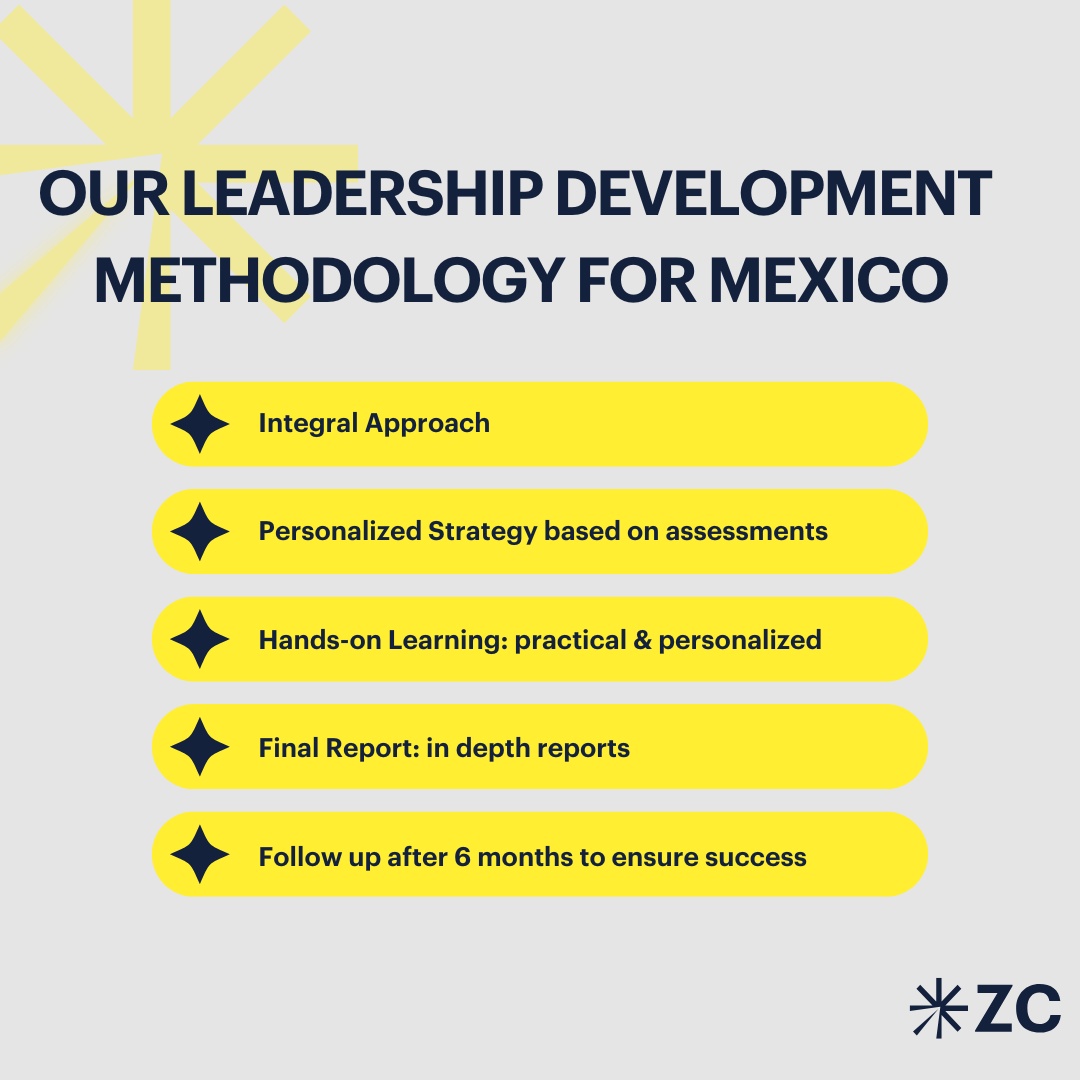
Through structured assessment calibrated to Mexico’s specific operating context — psychometric evaluation, behavioural interviews focused on the target mandate, and 360° references from both international and Mexican-side stakeholders — producing a personalised development plan anchored to the specific role the executive is preparing for. For family business succession, we structure the assessment and development timeline against the transition horizon. For nearshoring operations, against the scale milestones. Development milestones tracked quarterly. With a 92% closing rate across completed executive search mandates.