
The U.S. labor market has moved beyond many of the conditions that defined the immediate post-pandemic period. The Great Resignation has eased, employee quitting has normalized and overall unemployment remains moderate. However, this does not mean that identifying the right senior leader has become straightforward.
In July 2026, the U.S. unemployment rate stood at 4.1%. Among management, professional and related occupations, however, unemployment was only 2.9%. At the same time, U.S. employers still reported approximately 7.36 million job openings in June 2026.
Sources: U.S. Bureau of Labor Statistics, Employment Situation – July 2026 and U.S. Bureau of Labor Statistics, Job Openings and Labor Turnover Survey.
| U.S. Talent Indicator | Executive Search Implication |
|---|---|
| 4.1% unemployment | The overall labor market remains relatively stable as of July 2026. |
| 2.9% management & professional unemployment | Senior and professional candidate availability remains tighter than aggregate labor-market data suggests. |
| 7.36 million job openings | Employers continue to compete for talent despite normalization following the Great Resignation. |
| 94% expect AI transformation | U.S. employers increasingly need leaders capable of managing technology-enabled business transformation. |
Why Finding Executive Talent in the USA Remains Challenging
1. Competition Is Concentrated in Senior and Professional Talent
A softer labor market does not automatically translate into a large pool of qualified executives. In July 2026, unemployment among management, professional and related occupations was only 2.9%, compared with 4.1% across the labor market overall.
For highly specific C-suite and senior functional positions, the relevant candidate universe may therefore remain narrow even when aggregate hiring conditions appear more balanced.
Source: U.S. Bureau of Labor Statistics, Employment Situation – July 2026.
2. The Great Resignation Has Ended, but Executive Mobility Still Requires Active Search
The extraordinary employee movement associated with the Great Resignation is no longer the dominant feature of the U.S. labor market.
The national quits rate reached 3.0% during the peak period in 2021. By June 2026, it had fallen to 2.0%. This suggests a more stable employment market in which strong executives may be less likely to enter the candidate market voluntarily.
Sources: U.S. Bureau of Labor Statistics, The Great Resignation in Perspective and U.S. Bureau of Labor Statistics, JOLTS – June 2026.
For Executive Search in the USA, this reinforces the importance of direct candidate identification. The strongest person for a mandate may already be performing successfully in another organization and have little reason to respond to an advertised vacancy.
3. Executive Skill Requirements Are Becoming More Complex
Senior executives increasingly need a combination of functional expertise, commercial judgment, technological understanding and the ability to lead through uncertainty.
The World Economic Forum identifies analytical thinking, resilience and flexibility, leadership and social influence, technological literacy and empathy among the core capabilities employers continue to value. At the same time, AI, big data and cybersecurity are among the skills expected to grow most rapidly.
For U.S. employers specifically, 94% of respondents expect AI and information-processing technologies to transform their operations by 2030.
Source: World Economic Forum, Future of Jobs Report 2025 – United States.
4. Inefficient Hiring Processes Can Still Lose Strong Candidates
Senior candidates usually participate in a limited number of highly selective conversations rather than large numbers of recruitment processes. Long delays, unclear interview stages or inconsistent feedback can therefore weaken an organization’s ability to attract the strongest profiles.
Technology can improve scheduling, communication and information management, but efficiency should not replace senior judgment. For executive positions, candidate assessment still needs to examine the individual’s experience, leadership capabilities and suitability for the specific mandate.
5. AI-Enabled Recruitment Requires Human Oversight
Technology-enabled recruitment has evolved significantly since this article was first published. Employers can now use AI and automated tools for sourcing, screening and other parts of talent acquisition.
However, automation does not remove employer responsibility for selection decisions. The U.S. Equal Employment Opportunity Commission states that employment tests and selection procedures can violate federal anti-discrimination laws when they intentionally discriminate or disproportionately exclude protected groups without being job-related and consistent with business necessity.
Source: U.S. Equal Employment Opportunity Commission, Employment Tests and Selection Procedures.
For senior appointments, AI can support research and process efficiency, but final evaluation should remain connected to the actual requirements of the role and involve experienced human judgment.
6. A Wider Candidate Pool Requires Structured Assessment
Executive Search should extend beyond the candidates already visible through referrals, advertisements or a single professional network.
A broader market map can identify executives from different competitors, adjacent sectors, geographies and career paths. However, expanding the candidate universe only creates value when every candidate is assessed against consistent, role-relevant criteria.
This is particularly important when organizations are trying to broaden the experiences and perspectives represented within senior leadership without lowering the requirements of the mandate.
Key Challenges in Executive Search USA
Specialized Skill Requirements
Executives increasingly need a combination of functional expertise, international or multi-market experience, technological understanding and leadership capability. For specialised roles, conventional recruitment channels may not reach enough candidates who meet all of these requirements simultaneously.
Competition for Proven Leaders
Companies are not simply competing for available executives. They are often competing for leaders who are already performing successfully in other organizations. This makes the attractiveness of the mandate, decision-making authority, business strategy and compensation package important parts of the search.
Executive Compensation and Offer Alignment
Executive compensation may include base salary, annual incentives, long-term incentives, equity, benefits and other elements depending on the organization and position.
The challenge is not simply offering the highest package. Companies need to understand the candidate’s current position, expectations, risk associated with changing employer and the scope of the new mandate before structuring an offer.
Confidentiality and Discretion
Confidentiality remains particularly important for senior appointments. The organization may be replacing an incumbent leader, preparing a strategic change or approaching executives whose current employers are unaware that they are considering another position.
A direct and controlled Executive Search process can allow both clients and candidates to explore these conversations with greater discretion than a public recruitment process.
Executive Search Services in the USA
Zavala Civitas supports companies conducting Executive Search in the USA for senior and C-suite leadership positions.
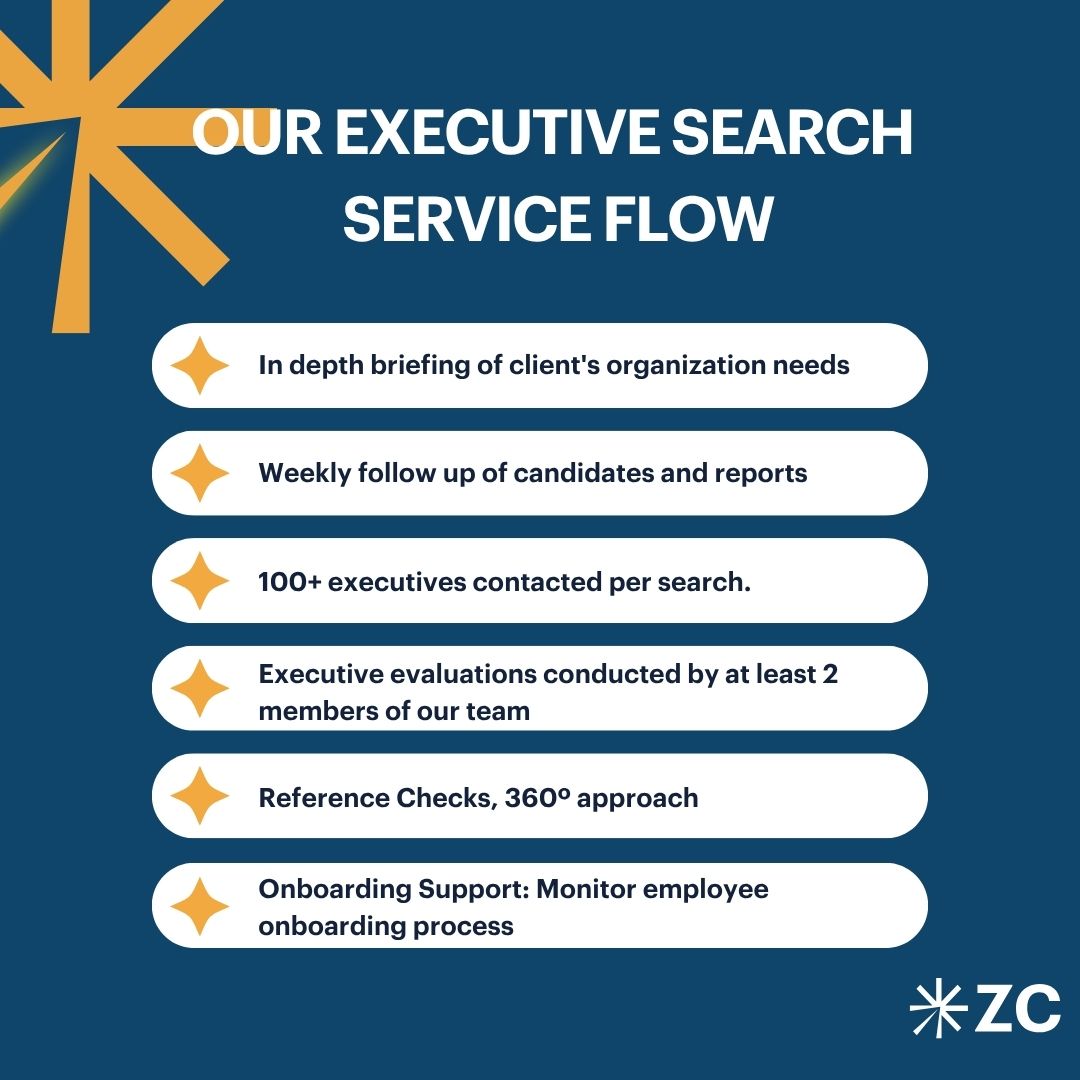
Our Executive Search methodology begins with an in-depth briefing to understand the client’s organization, business context and critical success factors for the role.
The process includes:
- Detailed definition of responsibilities and critical success factors.
- Market mapping and direct contact with more than 100 candidates per search.
- Client follow-up every 7–10 days with candidate and market reports.
- Candidate interviews conducted by at least two consultants.
- Quantitative and qualitative executive evaluation.
- 360º professional reference checks for selected candidates.
- Support during compensation negotiation and employment terms.
- Follow-up during the executive’s first six months of integration.
This approach is designed to combine technology-enabled market research with the human judgment required for complex leadership appointments.
Frequently Asked Questions About Executive Search in the USA
Is executive talent still difficult to find in the United States?
Yes, for many specialised leadership positions. In July 2026, unemployment among management, professional and related occupations was 2.9%, compared with 4.1% across the U.S. labor market overall. Availability also varies significantly by sector, function and geography.
Is the Great Resignation still affecting Executive Search in the USA?
The extraordinary quitting levels associated with the Great Resignation have eased. The national quits rate reached 3.0% during 2021 but was 2.0% in June 2026. Executive Search challenges today are therefore better explained by specialised skill requirements, competition for proven leaders and changing leadership capabilities than by unusually high voluntary turnover.
How is AI changing executive hiring in the United States?
AI is affecting both the capabilities companies expect from executives and the tools used during recruitment. The World Economic Forum reports that 94% of U.S. employers surveyed expect AI and information-processing technologies to transform their operations by 2030. Employers using automated selection tools should also ensure that their processes comply with applicable employment and anti-discrimination requirements.
Why is direct search important for senior positions?
Many strong executives are already employed and are not actively applying for new positions. Direct search allows companies to map the relevant market and confidentially approach leaders whose experience matches the mandate rather than limiting the process to active applicants.
How does Zavala Civitas conduct Executive Search in the USA?
Zavala Civitas begins with a detailed client briefing and definition of the critical success factors for the role. The process combines market mapping, direct contact with more than 100 candidates per search, interviews by at least two consultants, quantitative and qualitative assessment, 360º reference checks, compensation support and onboarding follow-up.
Learn more about our Executive Search methodology or contact us to discuss an executive leadership requirement in the United States.